

By Brent Thompson, Vice-President of vuTyme® Engineering at ADB
When people talk about innovation in TV platforms, the conversation often centers on adding more. More features, more integrations, more flexibility.
But in a hospitality setting, that approach quickly runs into limits.
A hotel TV session is short, unfamiliar, and often transactional. Guests want to relax, find something to watch, maybe connect their own device, and move on. They are not invested in learning the system in front of them. That single fact shapes every meaningful design decision.
After more than 15 years working on hospitality TV solutions, one principle has proven consistently valuable: simplicity drives better outcomes. And it’s needed at every level – not just for the guest using the TV, but for the hotel managing it and the operator delivering the service.
Designing for the user who won’t learn
In a residential environment, users build familiarity over time. They explore menus, customize settings, and gradually understand how the system behaves. That pattern does not apply in a hotel room.
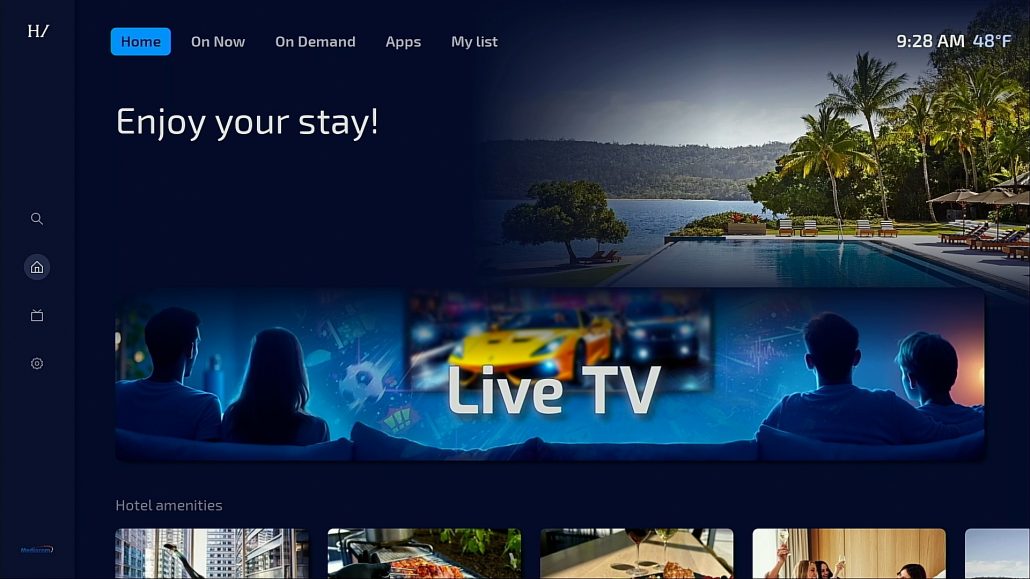
Hotel guests expect immediate clarity. If they cannot find what they need within seconds, they disengage or call the front desk. There is little patience for trial and error.
This creates a unique set of requirements for the interface:
- Clear navigation that works without explanation
- Readability from across the room
- Predictable behavior with a minimal remote
- Minimal steps to complete common actions
Every additional option competes for attention in a very short window of time. That forces a different level of discipline in how the experience is designed.
The hardest decision: what not to build
Modern platforms like Android TV provide significant computing power and access to a wide range of applications and services. The temptation is to include as many capabilities as possible. In a hotel environment, that quickly becomes a usability problem.
Extra features increase cognitive load. Complex navigation increases the likelihood of errors. A crowded screen reduces clarity, making it harder for guests to complete even simple tasks.
Effective design comes down to purposeful selection. The focus is on presenting features that matter most in a way that feels obvious and immediate.
Across our work with operators deploying solutions such as ADB’s vuTyme and vuTyme NOW, we’ve seen that the most effective implementations share common characteristics:
- A focused set of features aligned to real guest behavior
- Clean screen layouts that prioritize clarity over density
- Interaction paths that reduce the number of key presses
This approach is less about limiting capability and more about shaping it into something usable under real-world conditions.
Simplicity and the operational realities of hospitality
Poor usability in a TV system has immediate operational consequences for a hotel:
- Calls to the front desk
- Requests for in-room assistance
- Increased workload for hotel staff
- Friction in the overall guest experience
Over time, that friction does more than create inconvenience. It puts pressure on the relationship between the hotel and the operator providing the TV service. When staff lose confidence in the system, it becomes much harder for operators to retain and grow the account.
Unlike residential environments, guests are not expected to troubleshoot. Hotel staff cannot spend time diagnosing technical issues in every room. For the operator providing the TV service, it’s impossible to achieve scale in a system that depends on manual intervention. They also need to give their hotel partners confidence that the system will work consistently without ongoing attention.
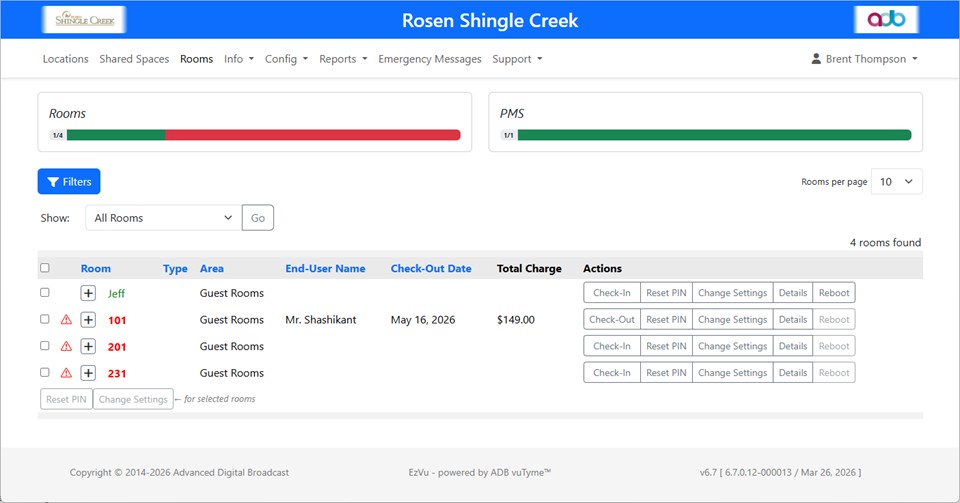
To achieve both scale and customer confidence, operators need visibility into what is happening at the device level. They need to know whether a box is offline, misconfigured, or simply not on the correct input. They need tools that allow them to be proactive – but without sending someone to the room or dispatching an engineer to the hotel.
This is why hospitality TV increasingly depends on a managed service model. Take ADB’s vuTyme NOW, for example. It’s a cloud-managed hospitality TV platform that combines in-room devices, centralized management, and operator-grade monitoring into a turnkey service. It allows operators to launch quickly with low upfront investment, while relying on ADB to manage the backend systems, updates, and higher-tier support.
For operators, that reduces the need to build and maintain a dedicated video operations team. For hotels, it provides peace of mind that the service is monitored, maintained, and supported without adding operational complexity. And for guests, it results in a system that simply works.
Flexibility without creating complexity
But simplicity should not limit the value of the service. Each hotel has its own requirements for the in-room experience. They want to promote amenities, share information, and maintain brand consistency.
Delivering that flexibility can easily introduce complexity for both guests and staff. The most effective approach is structured configuration, intuitive tools that allow hotel staff to:
- Update messaging and promotions
- Highlight on-property services
- Adapt content for different guest segments
- Communicate important information across rooms when needed
At the same time, the core experience remains consistent and easy to navigate.
In vuTyme NOW deployments, this balance allows operators to offer meaningful flexibility without increasing the burden on hotel staff or compromising usability for guests.
Designing for reliability and trust
Guests expect hotel technology to work immediately. When it does not, the perception of the entire property can be affected. That raises the bar for reliability.
From an engineering perspective, this means designing systems that are:
- Observable, so issues can be identified quickly
- Remotely manageable, so problems can be resolved without disruption
- Resilient, so common failures do not impact the guest experience
- Predictable, so users can navigate with confidence
These are technical considerations that directly influence both the experience of end users and hotel staff.
From simplicity to business value
Simplicity at the guest, hotel, and operator level translates into tangible business outcomes.
For operators, a platform that is easy to deploy and operate supports:
- Faster entry into new hospitality markets
- Lower upfront investment and reduced operational overhead
- More scalable service delivery
- Stronger positioning of bundled offerings
For hotels, it means:
- Less strain on staff
- Fewer service issues
- Greater confidence in the technology provided
These factors play a role in long-term relationships and revenue stability.
Simplicity as a competitive advantage
Hospitality expectations continue to evolve as guests compare every experience to the technology they use at home. Meeting those expectations requires careful adaptation to the realities of the environment.
Simplicity, applied consistently across the user experience, the operational model, and the deployment model, creates a service that is easier to use, easier to manage, and easier to scale.
That combination is increasingly important for operators looking to grow in the hospitality market without adding complexity to their business.
To learn more about how ADB’s vuTyme NOW is helping operators deliver simple, scalable hospitality experiences, contact our expert team.